
期刊Publication·2026 年 10 月刊October 2026
财富、自由与责任
Wealth, Freedom and Responsibility
变动世界中的家族办公室
Family Offices in a Changing World
摘要Summary
财富规模能够衡量资源,却不足以衡量资源的可用性。资产能否服务于长期目标,还取决于流动性、决策权限、执行条件,以及相关安排能否在人员和制度变化后继续运行。对于同时持有经营企业、金融资产与跨境权益的家庭,这些条件之间的关联,构成了财富治理的重要研究对象。
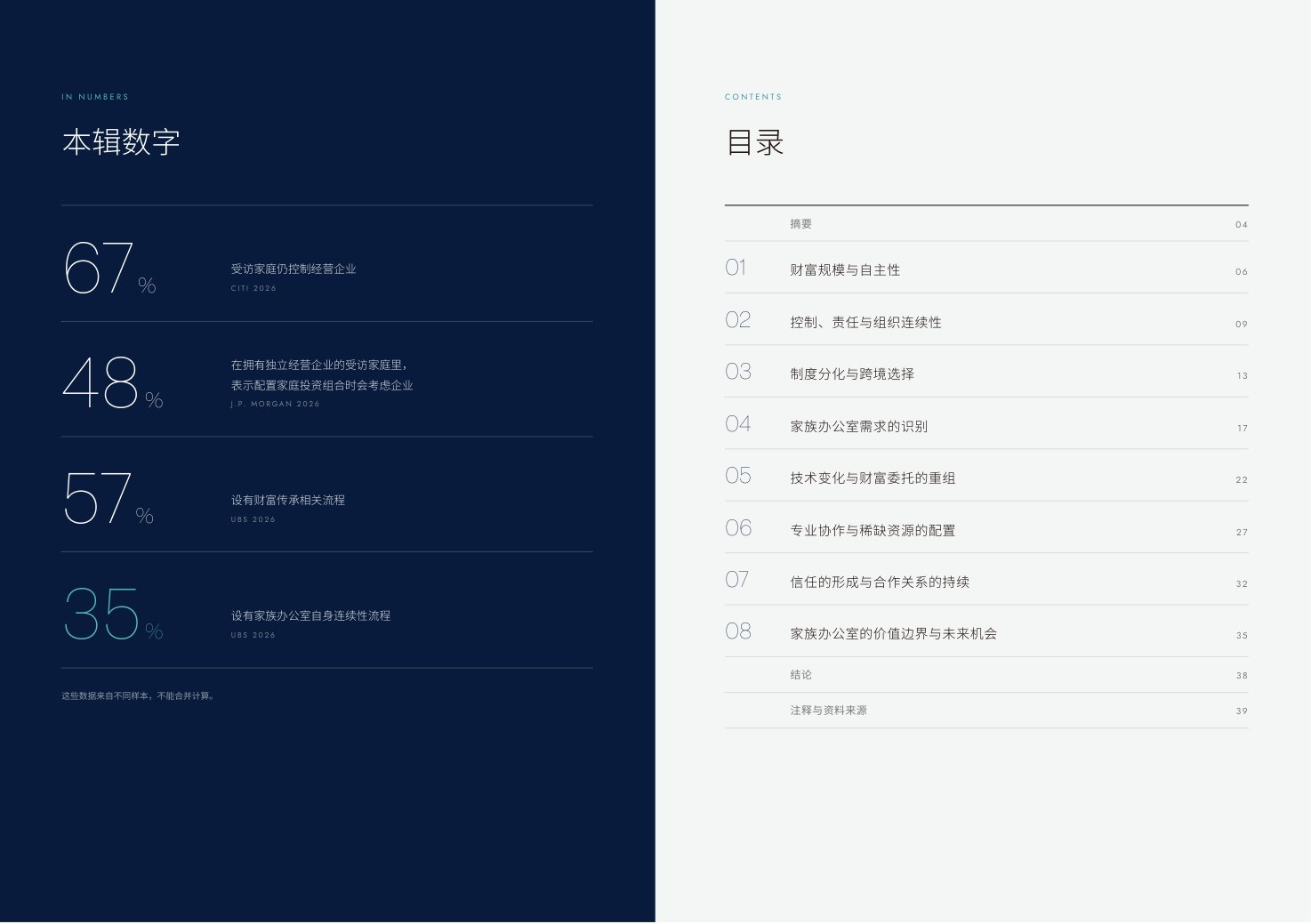
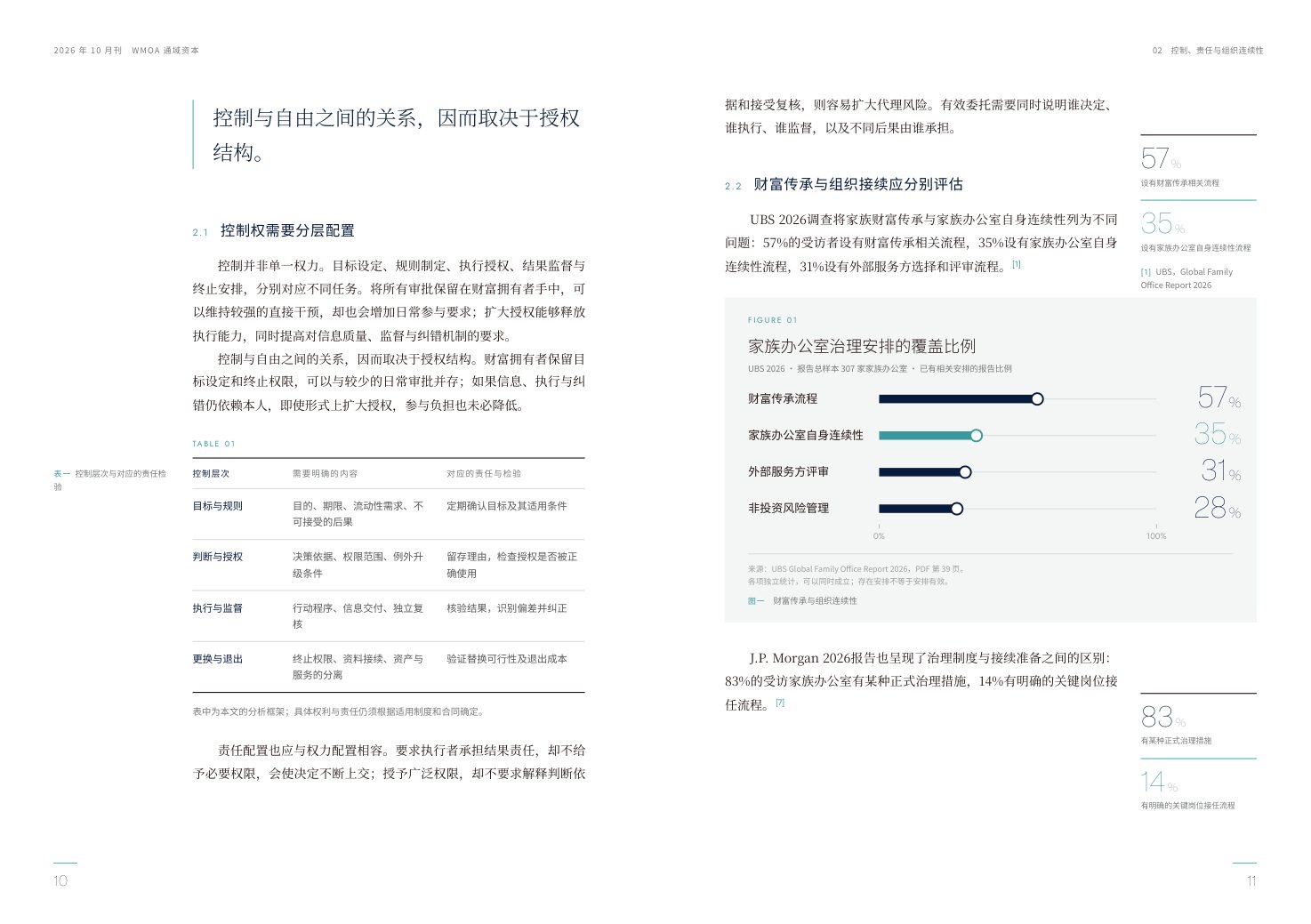
2025至2026年的机构研究提供了几个值得共同考察的发现。Citi调查中,67%的受访家庭仍控制经营企业;J.P. Morgan调查中,在拥有独立经营企业的受访家庭里,48%表示配置家庭投资组合时会考虑企业。UBS则将财富传承与家族办公室自身连续性分开统计,相关流程覆盖率分别为57%与35%。这些数据来自不同样本,不能合并计算,但提示了一个共同问题:资产、决策与组织之间的联系,需要被明确识别,不能由机构的存在或账户的划分推定已经解决。
本文基于与 WMOA 合作机构及客户开展的数十次深入对谈,以及对十三份家族办公室及全球财富报告的深入研究,结合对控制、责任与自主性的分析,提出四项判断。
The scale of wealth measures resources, but not how usable they are. Whether assets can serve long-term goals also depends on liquidity, decision authority, the conditions for execution, and whether the arrangements will continue to operate as people and rules change. For families that hold operating businesses, financial assets and cross-border interests at the same time, the links between these conditions are an important subject for the study of wealth governance.
Institutional research from 2025 to 2026 offers several findings worth reading together. In Citi's survey, 67% of responding families still controlled an operating business; in J.P. Morgan's survey, among responding families with a separate operating business, 48% said they take the business into account when allocating the family portfolio. UBS reported coverage of processes for wealth succession and for the continuity of the family office itself separately, at 57% and 35% respectively. These figures come from different samples and cannot be combined, but they point to a common question: the links between assets, decisions and organisation need to be identified explicitly, and cannot be assumed to be settled because an institution exists or accounts have been separated.
Drawing on dozens of in-depth conversations with WMOA's partner institutions and clients, a close study of thirteen family office and global wealth reports, and an analysis of control, responsibility and autonomy, this paper sets out four propositions.
四项判断Four propositions
财富增长会改变约束的构成。资金之外,个人参与能力、组织承接能力与制度条件,可能成为影响目标实现的主要因素。
Growing wealth changes the composition of constraints. Beyond capital, personal capacity to engage, organisational capacity to carry the work, and institutional conditions may become the main factors in whether goals are achieved.
家族办公室的价值应依据其对决策与执行的实际贡献评估,组织规模与服务范围不足以证明这种贡献。
A family office should be judged by its actual contribution to decisions and execution; organisational size and range of services are not sufficient evidence of that contribution.
跨境安排的意义在于增加经过验证的选择,地理数量本身不是评价标准。
The point of a cross-border arrangement is to add choices that have been tested; the number of geographies is not in itself a measure.
AI可能改变财富服务的分工与收费基础,既有委托关系需要逐项重新检验。
AI may change the division of labour and the fee basis of wealth services; existing mandates need to be re-examined one by one.
这些判断将人的有限性与组织设计联系起来:财富能够支持更长的时间跨度,个人持续投入的能力与意愿却存在边界。家族办公室是否有价值,取决于它能否在这些边界内,提高家庭理解、选择、执行、纠错和退出的能力。
These propositions connect human limits with organisational design: wealth can support a longer time horizon, but a person's capacity and willingness to remain engaged have limits. Whether a family office is valuable depends on whether, within those limits, it improves the family's ability to understand, choose, execute, correct course and exit.
目录Contents
摘要
04财富规模与自主性
06控制、责任与组织连续性
09制度分化与跨境选择
13家族办公室需求的识别
17技术变化与财富委托的重组
22专业协作与稀缺资源的配置
27信任的形成与合作关系的持续
32家族办公室的价值边界与未来机会
35结论
38注释与资料来源
39内页Inside
申请索取全文Request the full text
全文以 PDF 发送至您的工作邮箱。
The full text is sent as a PDF to your work email.
本刊面向家族、家族办公室、专业顾问与持牌机构,不面向零售客户。申请由团队人工处理,不会自动发送。
This publication is for families, family offices, professional advisers and licensed institutions, not retail clients. Requests are handled by the team and are not sent automatically.
本页内容仅为一般信息,不构成投资、法律或税务建议,亦不构成任何金融产品的要约或招揽。引用的第三方数据以其原始报告为准。
General information only. Not investment, legal or tax advice, nor an offer or solicitation. Third-party data are as stated in the original reports.